
Later, Jesus went across Lake Galilee (also known as Lake Tiberias). A great crowd of people followed him because they saw the miraculous signs he did in healing the sick. Jesus went up on the side of the hill and sat there with his followers. It was almost the time for the Jewish Passover festival. Jesus looked up and saw a crowd of people coming toward him. He said to Philip, “Where can we buy enough bread for all these people to eat?” He asked Philip this question to test him. Jesus already knew what he planned to do. Philip answered, “We would all have to work a month to buy enough bread for each person here to have only a little piece!” Another follower there was Andrew, the brother of Simon Peter. Andrew said, “Here is a boy with five loaves of barley bread and two little fish. But that is not enough for so many people.” Jesus said, “Tell everyone to sit down.” This was a place with a lot of grass, and about 5000 men sat down there. Jesus took the loaves of bread and gave thanks for them. Then he gave them to the people who were waiting to eat. He did the same with the fish. He gave them as much as they wanted. They all had plenty to eat. When they finished, Jesus said to his followers, “Gather the pieces of fish and bread that were not eaten. Don’t waste anything.” So they gathered up the pieces that were left. The people had started eating with only five loaves of barley bread. But the followers filled twelve large baskets with the pieces of food that were left. The people saw this miraculous sign that Jesus did and said, “He must be the Prophet who is coming into the world.” Jesus knew that the people planned to come get him and make him their king. So, he left and went into the hills alone. John 6:1-15 Easy
This is the moment when Jesus feeds the multitude, not with abundance already in hand, but with what looks painfully insufficient. A crowd is hungry. The disciples see the lack. Jesus sees an opportunity for trust. Philip calculates. Andrew hesitates. A boy offers what he has, five loaves and two fish, small enough to seem almost embarrassing against the need. Yet Jesus receives it without comment, without correction, without asking for more. He gives thanks. He breaks the bread. And somehow, everyone eats. Not just a little, but until they are filled. What stands out is that Jesus doesn’t create food instead of what’s offered. He multiplies what’s placed in His hands. The miracle begins with willingness, not adequacy. And when it’s over, nothing is wasted. Twelve baskets remain, a quiet reminder that when Jesus provides, He does so with care, order, and intention.These verse’s suggest that Jesus possesses foreknowledge of his actions, even when others may not. Seemingly minor offerings are noted to hold significance in his perspective. The text highlights the importance of gratitude preceding abundance and affirms that contributions made to Christ are never meaningless. There is recognition that he addresses both physical needs and underlying spiritual hunger. Although the crowd sought to make him king following these events, Jesus chose to withdraw, indicating his focus was on being trusted for his identity rather than celebrated solely for his works. Ultimately, the passage encourages individuals to offer their resources, regardless of limitations, with sincerity, trusting that they may be transformed beyond expectation. Such occurrences are characterized as subtle yet profound miracles that continue to manifest in daily life.
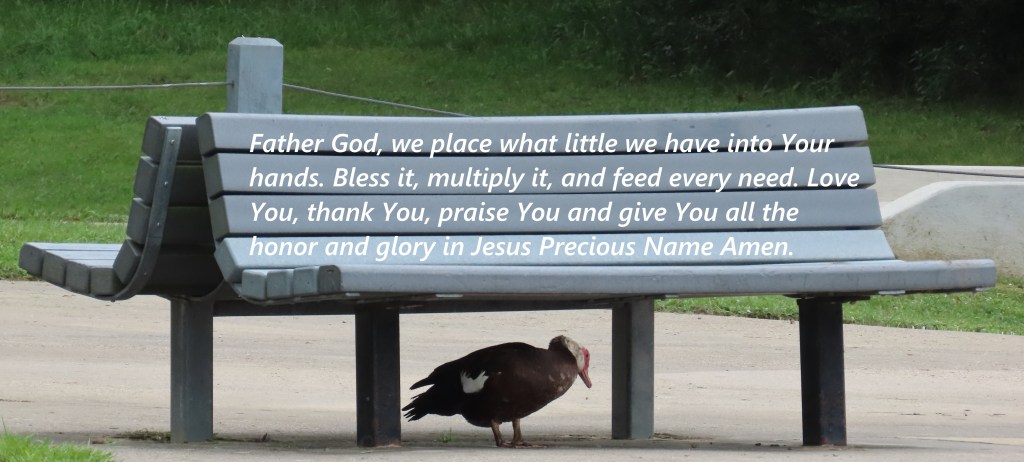
Father God, we place what little we have into Your hands. Bless it, multiply it, and feed every need. Love You, thank You, praise You and give You all the honor and glory in Jesus Precious Name Amen.
 "Prayer to Care"